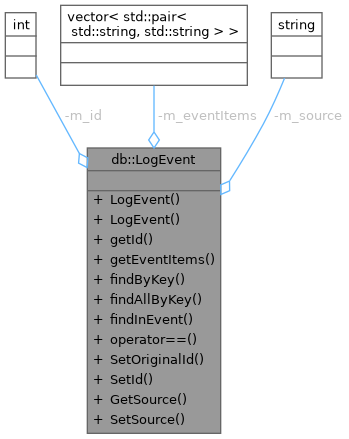
Represents a single, structured log event with key-value data. More...
#include <LogEvent.hpp>
Public Types | |
| using | EventItems = std::vector< std::pair< std::string, std::string > > |
| A collection of key-value pairs representing event data (eventFieldName, data). | |
| using | EventItemsIterator = std::vector< std::pair< std::string, std::string > >::iterator |
| Iterator type for traversing event items. | |
| using | EventItemsConstIterator = std::vector< std::pair< std::string, std::string > >::const_iterator |
| Const iterator type for traversing event items. | |
Public Member Functions | |
| template<typename... Args> requires util::Constructible<EventItems, Args&&...> | |
| LogEvent (int id, Args &&... args) | |
| Template constructor with perfect forwarding. | |
| LogEvent (int id, std::initializer_list< std::pair< std::string, std::string > > items) | |
| Constructs a LogEvent from an initializer list. | |
| int | getId () const |
| Gets the unique ID of the event. | |
| const EventItems & | getEventItems () const |
| Gets a const reference to the event's data items. | |
| const std::string | findByKey (std::string_view key) const |
| Finds a value by its key in the event's items. | |
| const std::vector< std::string > | findAllByKey (std::string_view key) const |
| Finds all values by its key in the event's items. | |
| EventItemsIterator | findInEvent (const std::string &search) |
| Finds an iterator to the first item matching the search term. | |
| bool | operator== (const LogEvent &other) const |
| Equality comparison operator. | |
| void | SetOriginalId (int originalId) |
| Sets the original ID before merge (stores as event data) | |
| void | SetId (int newId) |
| Updates the event's ID (used during merge to reassign sequential IDs) | |
| const std::string & | GetSource () const |
| Gets the source identifier for this event. | |
| void | SetSource (const std::string &source) |
| Sets the source identifier for this event. | |
Private Attributes | |
| int | m_id |
| Unique event identifier. | |
| EventItems | m_eventItems |
| The structured data of the event. | |
| std::string | m_source |
| Source identifier for multi-file merge. | |
Detailed Description
Represents a single, structured log event with key-value data.
A LogEvent encapsulates a log entry as a collection of key-value pairs, providing efficient access to structured log data. Each event has a unique identifier and contains metadata such as timestamps, severity levels, and custom attributes.
- Design Philosophy
- LogEvent is optimized for:
- Memory efficiency through move semantics and perfect forwarding
- Integration with filtering and display systems
- Support for multi-source event merging with original ID tracking
- Key Features
- Key-value lookup: O(n) linear scan over a typically small field list — deliberately not a per-event hash index (see findByKey())
- Multiple source tracking: Identifies events from different log files
- Original ID preservation: Retains pre-merge IDs for traceability
- Flexible construction: Supports initializer lists and perfect forwarding
- Thread Safety
- This class is not thread-safe. External synchronization is required when accessing LogEvent instances from multiple threads. For thread-safe collection management, use EventsContainer instead.
- Memory Management
- LogEvent uses move semantics and perfect forwarding where possible to minimize unnecessary copying of large data sets. Events are typically moved into EventsContainer for storage.
- Usage Examples
Creating events from initializer list:
Searching for values:
Iterating through event data:
Working with merged events:
- See also
- EventsContainer for thread-safe collection management
- FilterManager for filtering events based on key-value data
Member Typedef Documentation
◆ EventItems
| using db::LogEvent::EventItems = std::vector<std::pair<std::string, std::string> > |
A collection of key-value pairs representing event data (eventFieldName, data).
◆ EventItemsConstIterator
| using db::LogEvent::EventItemsConstIterator = std::vector<std::pair<std::string, std::string> >::const_iterator |
Const iterator type for traversing event items.
◆ EventItemsIterator
| using db::LogEvent::EventItemsIterator = std::vector<std::pair<std::string, std::string> >::iterator |
Iterator type for traversing event items.
Constructor & Destructor Documentation
◆ LogEvent() [1/2]
|
inline |
Template constructor with perfect forwarding.
Constructs a LogEvent with an ID and forwards arguments to EventItems constructor. This enables efficient construction from various argument types without unnecessary copies.
- Template Parameters
-
Args Variadic template arguments for EventItems construction
- Parameters
-
id The unique identifier for the event (typically assigned by parser) args Arguments forwarded to EventItems constructor
- Note
- Uses C++20 concepts to constrain args that can construct an EventItems object
- Usage
- // From vector of pairsstd::vector<std::pair<std::string, std::string>> data = {...};db::LogEvent event(123, data); // or std::move(data)// From initializer list (handled by overload)
- See also
- LogEvent(int, std::initializer_list)
◆ LogEvent() [2/2]
|
inline |
Member Function Documentation
◆ findAllByKey()
| const std::vector< std::string > db::LogEvent::findAllByKey | ( | std::string_view | key | ) | const |
Finds all values by its key in the event's items.
Performs a linear search through the event's key-value pairs to find all occurrences of the specified key.
- Parameters
-
key The key to search for
- Returns
- const std::string The corresponding value, or empty string if not found
- Note
- Returns the first matching value if duplicate keys exist
- Complexity
- O(n) where n is the number of items in the event
◆ findByKey()
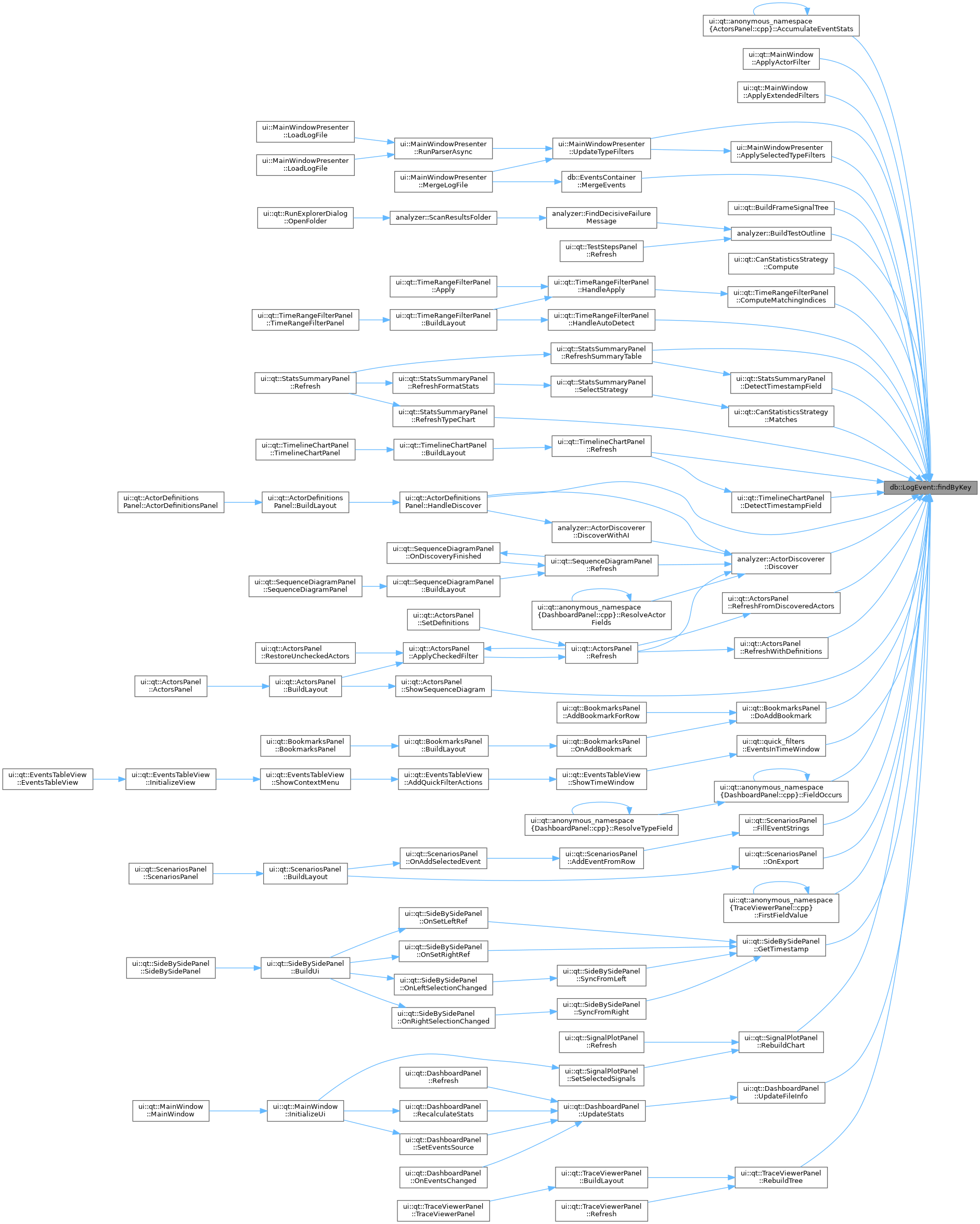
| const std::string db::LogEvent::findByKey | ( | std::string_view | key | ) | const |
Finds a value by its key in the event's items.
Performs a linear scan to retrieve the value associated with the first occurrence of a key. If the key is not found, returns an empty string.
- Parameters
-
key The key to search for (e.g., "timestamp", "level", "message")
- Returns
- const std::string The corresponding value, or empty string if not found
- Note
- Returns the first matching value if duplicate keys exist in event data
- Example
- db::LogEvent event(1, {{"timestamp", "2025-03-15"},{"level", "INFO"},{"message", "User logged in"}});std::string missing = event.findByKey("nonexistent"); // ""
- See also
- findAllByKey() for retrieving all values with the same key
- findInEvent() for substring search in both keys and values
- Complexity
- O(n) where n is the number of fields in the event. Deliberately not backed by a per-event hash index: with typically a handful to a few dozen fields, a linear scan over a contiguous vector is both cheaper to build (no per-event heap allocations) and faster to query in practice than an unordered_map at this scale — and at 100M+ events, skipping that per-event hash table avoids the dominant memory cost.
◆ findInEvent()
| LogEvent::EventItemsIterator db::LogEvent::findInEvent | ( | const std::string & | search | ) |
Finds an iterator to the first item matching the search term.
Searches through both keys and values for the specified search term.
- Parameters
-
search The term to search for in keys and values
- Returns
- EventItemsIterator Iterator to the found item, or end() if not found
- Note
- This method performs a substring search, not exact matching

◆ getEventItems()
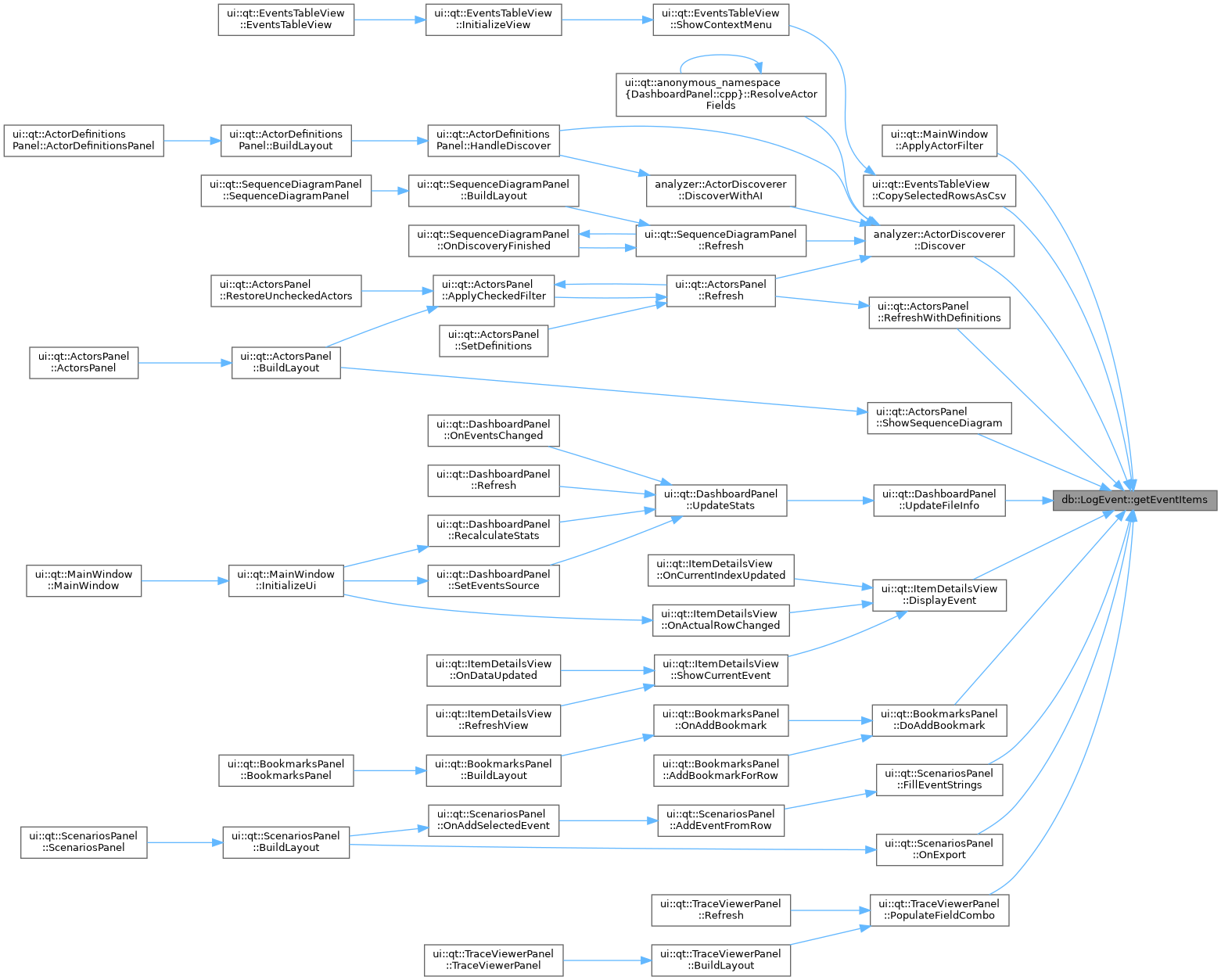
| const LogEvent::EventItems & db::LogEvent::getEventItems | ( | ) | const |
Gets a const reference to the event's data items.
- Returns
- const EventItems& Reference to the internal items collection
- Note
- Use this method for read-only access to avoid unnecessary copying
◆ getId()
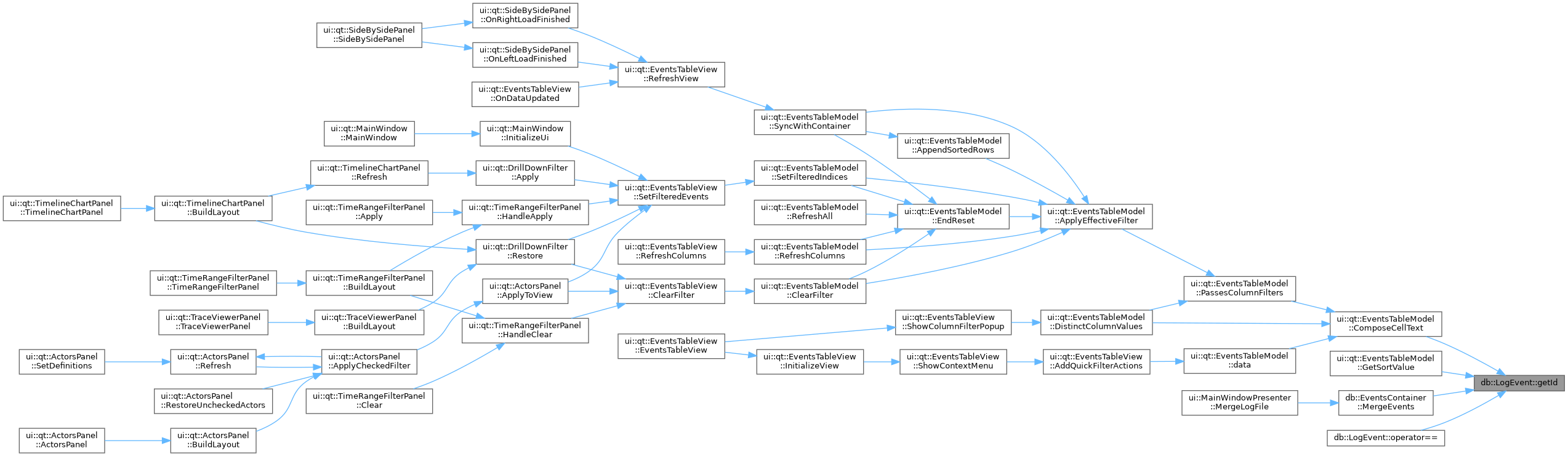
| int db::LogEvent::getId | ( | ) | const |
Gets the unique ID of the event.
- Returns
- int The event's unique identifier
- Note
- Event IDs should be unique within a single log file or session
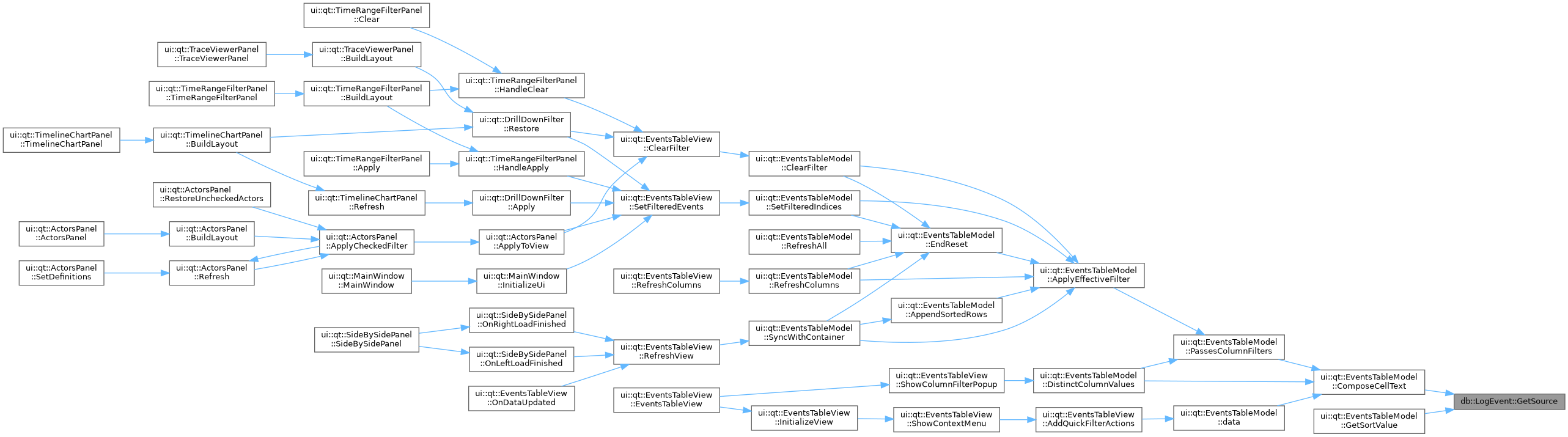
◆ GetSource()
|
inline |
Gets the source identifier for this event.
- Returns
- const std::string& The source identifier (empty for legacy events)
◆ operator==()
|
inline |
Equality comparison operator.
Two LogEvent objects are considered equal if they have the same ID. The actual event data is not compared.
- Parameters
-
other The LogEvent to compare against
- Returns
- bool true if both events have the same ID
- Note
- This comparison is based solely on ID, not event content

◆ SetId()
| void db::LogEvent::SetId | ( | int | newId | ) |
Updates the event's ID (used during merge to reassign sequential IDs)
After merging events, this method reassigns event IDs to be sequential based on their position in the merged list. The original ID is preserved separately via SetOriginalId().
- Parameters
-
newId The new event ID to assign

◆ SetOriginalId()
| void db::LogEvent::SetOriginalId | ( | int | originalId | ) |
Sets the original ID before merge (stores as event data)
When merging events from different sources, the original event ID is preserved as a data field so users can see both the original ID and the new merged ID.
- Parameters
-
originalId The original event ID before merge

◆ SetSource()
|
inline |
Sets the source identifier for this event.
- Parameters
-
source The source identifier (e.g., file name or alias)
Member Data Documentation
◆ m_eventItems
|
private |
The structured data of the event.
◆ m_id
|
private |
Unique event identifier.
◆ m_source
|
private |
Source identifier for multi-file merge.
The documentation for this class was generated from the following files:
- src/application/db/LogEvent.hpp
- src/application/db/LogEvent.cpp