Named filter-profile save/restore panel and FilterProfile data type. More...
#include "TimeRangeFilterPanel.hpp"#include "Error.hpp"#include "Result.hpp"#include <nlohmann/json.hpp>#include <QWidget>#include <set>#include <string>#include <vector>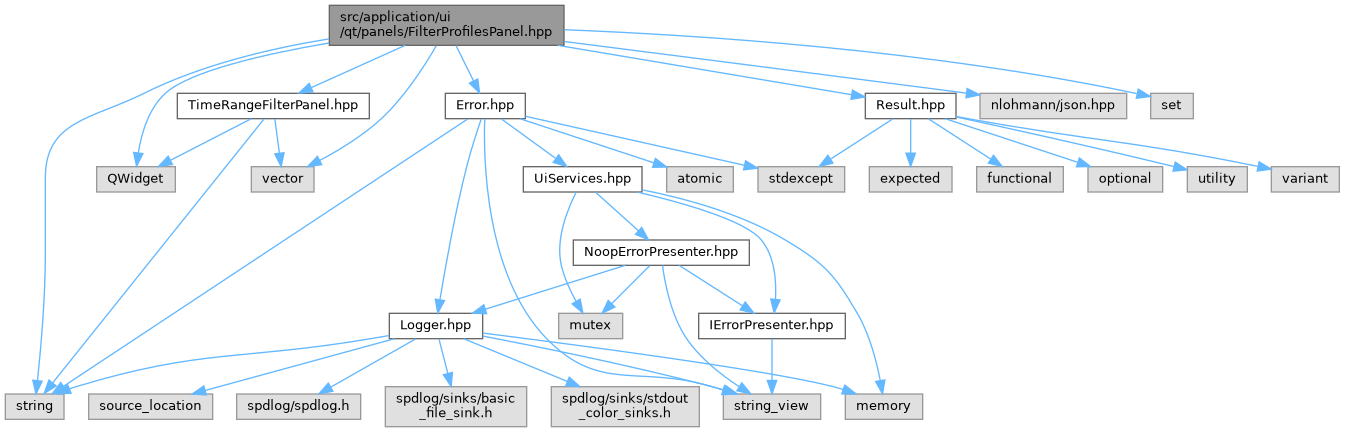
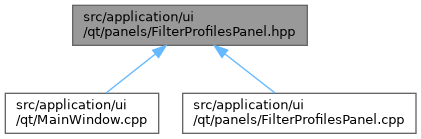
Go to the source code of this file.
Classes | |
| struct | ui::qt::FilterProfile |
| Snapshot of all active filter state that can be named and persisted. More... | |
| class | ui::qt::FilterProfilesPanel |
| Panel for saving and restoring named filter profiles. More... | |
Namespaces | |
| namespace | ui |
| namespace | ui::qt |
Detailed Description
Named filter-profile save/restore panel and FilterProfile data type.
A filter profile is a lightweight snapshot of the complete filter state:
- Time range (field name + from/to bounds + active flag)
- Actor check state (set of unchecked actor keys)
- Type filter selection (optional; only stored when at least one type exists)
Profiles are persisted as JSON in the application data directory (<appdata>/filter_profiles.json) and are loaded automatically on start-up.
Interaction model
The panel does not directly access other filter panels. Instead it delegates through MainWindow via two signals:
SaveRequested(name)→ MainWindow gathers state →StoreProfile()ProfileLoadRequested(profile)→ MainWindow applies each field to the appropriate panel
Actor key encoding
Each entry in FilterProfile::uncheckedActors is a composite string of the form "<defName>\0<actorName>". The NUL character serves as a delimiter that cannot appear in either component. Use ActorKey::Encode() / ActorKey::Decode() for safe construction and decomposition.
- Date
- 2026